
How Lawyers & Accountants Can Turn Speaking Engagements into Business Development Gold
By Sue-Ella Prodonovich | Published March 2026
You've spent hours preparing for a 45-minute talk. You've checked the slides twice. You might even have rehearsed once. And then it's over.
At that point, many professionals walk away thinking: “That went well” - and leave it at that.
That's the missed opportunity.
A speaking engagement isn't just a once-off event. My three-stage framework: (1) Preparation + (2) Presentation + (3) Amplification, turns a 45-minute talk into weeks of business development activity.
Here's how to unlock the full value…
STAGE 1: PREPARATION - BEFORE YOU TAKE THE STAGE OR WEBINAR SCREEN
Design for Your Target Market
Don't prepare for "the audience" in general. Sharpen your focus.
Think about who in the room best ‘fits’ with your network and your practice. Not every contact is a target client to pursue (very pipeline thinking) – expand your view to platform thinking (building your practice ecosystem). Think about those who refer conflicts, those who work in adjacent areas, or those who can open doors even if they're not clients themselves.
Read my article on platform thinking “The Key To Successful Practice? Stop Focussing on Winning Work”.
Ask yourself: What do I want these specific people to think, feel, or do afterwards?
That question shifts you from delivering information to creating an outcome. It's a small adjustment. It changes everything about how you prepare.
Maximise Networking Before the Event
(i) Research who's coming
Ask the organisers to see what audience information they can share. No worries if they can’t provide names but most will provide details about who they are promoting to; where they get registrants from, and job titles or companies so you can tailor your talk. (After all, having a tailored talk is in their interest).
(ii) Build anticipation beforehand
Invite someone from your team and your external network (a client, a referrer, a friendly expert you’d like in the audience). A speaking gig gives you a natural reason to reach out.
If they can't join you - no matter. The invitation is the gift, not the acceptance.
Connect with other speakers and sponsors. These relationships often become lasting ones.
If the event is open to registrations, let people know you're speaking and how they can sign up. That's useful.
If attendance is closed, think twice before posting. Self-promotional* content can erode trust, especially in Australia and New Zealand (the ‘tall poppy syndrome’ is alive and well down under).
(iii) Structure your talk well
When structuring your presentation, start with your opening and closing. These anchor everything else.
Plan for tough questions and time pressure. If the program runs long, know what you can cut.
Create something people can take home - a checklist, a summary, a resource, a QR code.
And yes: check the room and the tech setup beforehand. It's worth the peace of mind.
STAGE 2: PRESENTATION - WHAT TO SAY AND HOW TO SAY IT
Sound Confident While Staying Approachable
Here's something interesting about confidence in professional services. It's less about certainty and more about credible authority.
The lawyers and accountants who earn the most respect aren't the know-it-alls. They acknowledge complexity without apologising for it. They show their thinking, not just their conclusions. After all, that’s the type of person who’d be easy to work with.
Try these language patterns for credible authority…
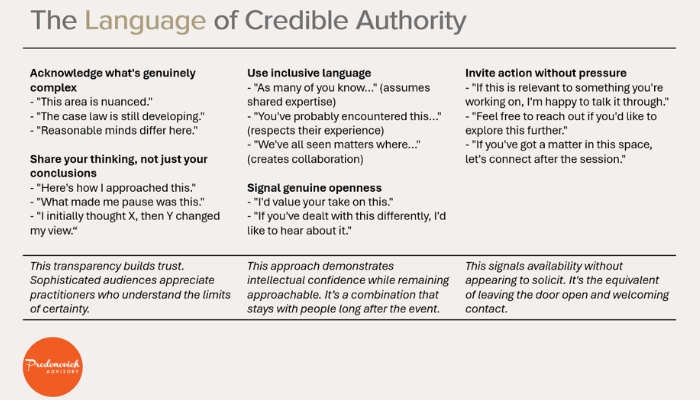
Language patterns for professionals that build credible authority and ‘likeability’.
Manage Your Nerves Physically
Your voice and body matter for first impressions. Nerves can tighten your vocal cords and make you rush. Here's how to counteract that:
- Slow down deliberately. Confident speakers take their time.
- Pause after key points, because silence signals control.
- Stand tall. Feet shoulder-width apart, shoulders back; and
- Slightly lower your pitch
None of this is complicated. It's just easy to forget when you're nervous.
STAGE 3: AMPLIFICATION - WHERE THE REAL VALUE LIVES
This is the stage most professionals skip entirely.
You've already invested hours preparing for a 45-minute talk. That reaches perhaps 50 people in the room. Amplification lets you extend that reach significantly, without starting from scratch. Think of it as making your effort work harder.

After the presentation: Sue-Ella’s amplification playbook
THE NUMBERS ADD UP
When you treat a speaking engagement as a three-stage platform, the value multiplies.
One presentation can generate:
CPD and MCLE points - professional development as a by-product
One more concrete evidence point to refer to in your public profile(s), your pitch profiles or capability statements, and even award submissions
10+ direct touchpoints with your primary audience
100+ indirect touchpoints via LinkedIn, article readers, and newsletter subscribers
5+ valuable relationships - speakers, sponsors, targeted attendees
3+ content pieces - articles, videos, podcasts
Ongoing visibility in your area of expertise
Not bad for a talk you were already giving!
CHOOSE LESS. THEN OBSESS.
Many lawyers and accountants are so busy they rarely get to pause between commitments. But more activity isn't always the answer.
Management researcher Morten Hansen studied what separates top performers from the rest. His finding? They don't do more. They choose carefully - and then extract every bit of value from what they do. That's the principle behind his book Great at Work (2018).
Speaking engagements are exactly that kind of high-leverage commitment. One talk can profile your expertise, show people what it's like to work with you, expand your network, and generate content - all at once.
The question isn't whether to accept speaking invitations. The question is: how well can you use them?
Whether you're presenting at legal conferences, accounting events, client seminars, or business networking groups - this three-stage framework will help.
Preparation + Presentation + Amplification.
FREQUENTLY ASKED QUESTIONS
How should lawyers and accountants follow up after a speaking engagement?
Send a brief, helpful email within 24 hours. Include a summary of your key points, answers to questions raised during the session, and links to any resources you mentioned. Focus on adding value, not selling. The goal is to stay top of mind for the right reasons.
How do you repurpose a speaking engagement into content?
Your presentation can become three to five LinkedIn posts, one or two blog articles, an email newsletter, and short video clips. Each format extends your reach to people who weren't in the room. One 45-minute talk, properly repurposed, can generate weeks of content.
What's the biggest mistake professionals make with speaking engagements?
Treating the talk as the end point. The real business development value comes from what you do before the event - and especially from amplification afterwards. Most professionals invest heavily in preparation and delivery, then walk away. That's where the value gets left behind.
How do you build confidence as a professional speaker?
Slow down deliberately and pause after key points. Use language that acknowledges complexity without apologising for it - phrases like "reasonable minds differ here" or "here's how I approached this." Confidence in professional services comes from credible authority, not certainty. Audiences trust people who understand the limits of what they know.
How many touchpoints can one speaking engagement generate?
When you use Sue-Ella’s three-stage framework - preparation, presentation, and amplification - a single engagement can generate 10+ direct touchpoints, 100+ indirect touchpoints via content, 3-5 content pieces, and 5 or more valuable new relationships. The key is treating the event as a platform, not a performance.
WANT MORE?
If you’d like to discuss your Firm’s approach to business development email Sue-Ella.
If you’re a busy practitioner who wants to sound out ideas for an upcoming presentation book a private consultation with Sue-Ella here.
References and Further Reading
Sue-Ella’s articles:
The Key To Successful Practice: Stop Focusing on Winning Work and
How Not To Be a Jerk in a Virtual Presentation
Clear J. (2018) Atomic Habits: Tiny Changes, Remarkable Results
Hansen M (2018) Great at Work, Simon & Schuster, UK
Maister D., Green C., Galford R (2000) The Trusted Advisor Equation
McKeown, G (2014) Essentialism : The Disciplined Pursuit of Less Crown Currency, 10th Edition in 2024.

Sue-Ella Prodonovich
Sue-Ella is the Principal of Prodonovich Advisory, a business dedicated to helping professional services practices sharpen their business development and client engagement practices.
She works with law and accounting firms on Business Development strategy and support structures, leadership and professional-development programs, and designing client-listening initiatives.
A long time ago she was a Senior Presentation Skills Trainer with Rogen (when we’d record your presentation on a VHS cassette!)
She co-facilitates firm planning retreats and delivers public workshops such as Business Skills for Lawyers.
And through her BD45™ service, she assists individuals with their personal business-development plans.
Connect on LinkedIn or visit prodonovich.com.au
©Prodonovich Advisory. Please respect our copyright and the effort that went into producing this article. This article, and any portion of it, may not be reproduced or used in any manner whatsoever without the express written permission of the author.