
Trust Is Borrowed Before It’s Earned: What Every Early Career Professional Should Know
By Sue-Ella Prodonovich | 30 September 2026
Key takeaways
Early in your career, most of the trust you receive is borrowed from your qualifications, your firm and the people you work with.
Calculus-based trust is a rational judgement: can I rely on the work you do? Relational trust rests on human connection (do I like you?) and grows from repeated interactions over time.
Maister's Trust Equation is useful as four habits: be believable, do what you said, make it safe to talk, and focus on the client's interests.
Lateral hires meet the same pattern, because trust in a new firm and team has to be built.
Wow. My last article, on referral etiquette and how referrals run on borrowed trust, certainly got people talking, and much of the talk was about trust in individuals.
Being trustworthy is a cornerstone of professional life but it’s also an abstract idea. Everyone wants to be trusted, but how do you go about building that quality?
The answer starts earlier than most people think, with trust you’ve yet to earn. Here is where it comes from, and the everyday habits that turn it into a record of your own.
Trust is borrowed before it’s earned
Borrowed trust is the confidence people give you because someone or something vouches for you: your qualification, your firm, a referrer or a shared background. You rely on it until you have built a record of your own.
Nobody trusts a stranger on their own merits. They trust whatever stands behind the stranger - the “proof sources” that validate you. Some proof is rational, like your qualifications and awards. (On that matter, it still surprises me that most lawyers in Australia and New Zealand keep their range of post-nominals on the down-low.)
Other proof is inferred from common ground, like gender, faith, sport or how much you like Kylie. (On that matter, how good was last weekend’s AFL Grand Final!)
A referrer lends you their standing too and early in your career, almost all of your trustworthiness is borrowed from the people who vouch for you.
Two forms of trust and the driver between them
Trust experts, Profs Roy Lewicki & Barbara Bunker, gave us a useful map of how another person decides to trust you with two forms of trust…
Calculus-based trust (or transactional trust). A rational choice, based on credible information about your competence (like your qualifications or deals list) and the safeguards in place if things fall short (like a service level agreement).
Relational trust (or identification-based trust). The experience of you. It builds over repeated interactions and forms positive expectations about what it’s like to work with you: your dependability, how easy you are to work with, and the interests you share. This is the 'humaning' part of work.
Between the two sits knowledge and your expertise. The better someone knows you, the better they can predict you. As Lewicki puts it, knowledge "drives the trust I have, but it is not a component of trust". Over time, what people learn about you and your service carries a relationship from transactional towards personal.
Supporting everything sits institutional trust: your firm's name and your profession's standing. If trust in your firm or your profession takes a hit, you’ll need lean on your other sources of trust.
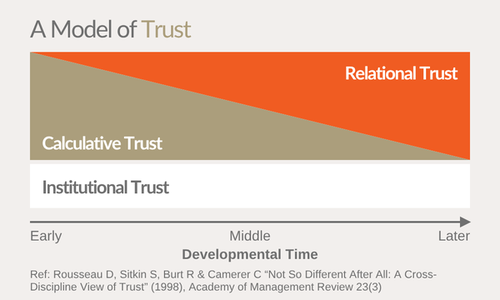
Calculative trust gives way to relational trust as a relationship develops, with institutional trust underneath. Identification-based trust is relational trust at its broadest.
Where you borrow trust early in your career
Here are three “proof sources” early-career professionals can protect and build…
Your qualifications. List all your qualifications and accreditations, and keep adding credible programmes and CPD. If you win an award, join an exchange programme, are nominated for a leadership course or contribute to an article, single it out on your profile.
Your firm's reputation. At the start of your career, you build trust under the halo of your firm: its corporate reputation, its capabilities and the standing of individual partners. Think, and learn, like an apprentice. Attend your partners' speaking engagements, support practice group networking events, join firm socials and become known as a trustworthy team member.
Your networks and communities. Your networks do not need to be another job to do. Often they are closer than you think: hobby and interest groups, alumni and affinity groups, professional associations, industry groups, special projects and think tanks.
In a Legal Practice Management Course, one participant shared that they earned the trust of their biggest client because they both loved ultra-long-distance cycling. Shared interests give people an easy reason to trust you.
The Trust Equation And personal habits
No conversation about trust in a professional services firm gets far without Maister’s Trust Equation. In this model most of the attention on trust turns to the individual's actions: how to make yourself more trustworthy. Here’s what each term looks like in practice …
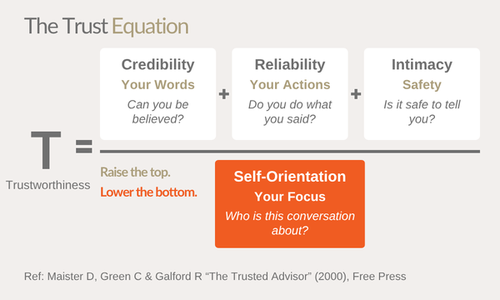
Credibility, reliability and intimacy build trustworthiness. Self-orientation diminishes it.
Credibility: can you be believed? For example, say "I’ll check and come back to you by three o'clock" instead of guessing an answer on the spot.
Reliability: do you do what you say’ you’ll do? This goes to the predictability of your work, and people judge it over many interactions. You might be the smartest person in the room, but if you’re not dependable or you’re hard to work with, your trustworthiness dims.
Intimacy: is it safe to tell you? Intimacy is how you handle the human side of work relationships - your empathy and sensitivity. Can a client or colleague tell you something without regretting it later? Do you consider the whole person and where they’re at, beyond the facts of the matter?
Self-orientation: who is this about? The more that conversations, or sales pitches, are about you, the less trustworthy (and more tedious) you become. It’s one reason I dislike the ‘elevator pitch’. So instead of reciting your firm’s achievements when networking, ask follow-up questions that build rapport.
None of these actions is heroic. They’re small, repeated steps that, over time, become a record of your trustworthiness. For more ideas I’ve included Covey's 13 Behaviours of High Trust in the references. It’s a good, practical checklist for early-career professionals.
Why lateral hires feel it too (it’s not personal)
Lateral partners often expect their reputation to travel with them intact. Most of it does, especially with clients who know you well, but your new colleagues need time to build relational trust and to see how you treat a client they have looked after for years.
So they fall back on small referrals and watch closely. That’s not a slight. It’s comparable to the trust ledger a graduate starts with.
Read more about How to Get Old Clients to Follow You To A New Firm
What to tell your team
If you lead people, match the opportunities to build trust to each person's experience and standing. Once your people know who the firm serves and can reliably deliver good work, they’re better placed to branch out. That’s when they build deeper relationships, broaden their networks and develop new business.
Frequently asked questions
-
Borrowed trust is the confidence clients and colleagues give you because something vouches for you, such as your qualification, your firm or a referrer. Early-career professionals and lateral hires rely on it until they have built a record of their own. It comes with an obligation to protect the standing of whoever lent it.
-
Calculus-based trust is trust based on rational choice, typical of relationships built on economic exchange. The client weighs credible evidence, such as credentials, references and track record, against the risk and the consequences of failure. It works much like a procurement decision, and you earn it through reliable, checkable delivery
-
The Trust Equation comes from The Trusted Advisor (2000) by David Maister, Charles Green and Robert Galford. It says trustworthiness equals credibility plus reliability plus intimacy, divided by self-orientation. In practice, be believable, do what you said, make it safe for clients to speak openly, and keep the focus on them.
-
Roy Lewicki and Barbara Bunker's 1996 model named three forms: calculus-based, knowledge-based and identification-based. Lewicki later concluded that knowledge drives trust rather than being a form of it, so this article treats knowledge as the link between the two forms.
-
New colleagues know your technical reputation but have no evidence yet of how you’ll treat their clients. So they start with small referrals or watch what happens when their colleagues introduce you to a project. Deliver visibly, report back without being chased, and larger referrals will follow.
Want more?
If you’d like to know more about building trust early in your career, email Sue-Ella or get in touch.
References and further reading
Sue-Ella’s articles
Referrals Run On Borrowed Trust: Seven Questions Your Colleagues Ask Before They Refer You
How to Get Old Clients to Follow You To a New Firm
External references
Casciaro T and Sousa Lobo M (2005) Competent Jerks, Lovable Fools, and the Formation of Social Networks. Harvard Business Review, June 2005.
FranklinCovey (2021) The 13 Behaviours of High Trust. FranklinCovey, UK blog, 11 October 2021.
Gillespie N (2017) Trust Dynamics and Repair: An Interview with Roy Lewicki. Journal of Trust Research 7(2), 204 to 219.
Lewicki R J and Bunker B B (1996) Developing and Maintaining Trust in Work Relationships. In Kramer R M and Tyler T R (eds), Trust in Organizations: Frontiers of Theory and Research. Sage.
Maister D H, Green C H and Galford R M (2000) The Trusted Advisor. Free Press.
Rousseau D M, Sitkin S B, Burt R S and Camerer C (1998) Not So Different After All: A Cross-Discipline View of Trust. Academy of Management Review 23(3), 393 to 404.
About Sue-Ella

Sue-Ella Prodonovich expert in Business Development for Professional Services firms
Sue-Ella is the Principal of Prodonovich Advisory, a business dedicated to helping professional services practices sharpen their business development practices.
She works with law and accounting firms on Business Development strategy and support structures, leadership and professional-development programs, and designing client-listening initiatives.
She also co-facilitates firm planning retreats and delivers public workshops such as Business Skills for Lawyers.
Through her BD45™ service, she assists individuals with their personal business-development plans.
Connect on LinkedIn or visit prodonovich.com.au
© Prodonovich Advisory. This article was thought of and prepared by a human with AI assistance. It took ages! Please respect our copyright and the effort taken to produce the original material in this document. This document or any portion thereof may not be reproduced or used in any manner whatsoever without the express written permission of the author.